Travel Behemoths Turn to AI and Fintech in Response to Market Changes
Leaders in the travel industry gather to discuss how artificial intelligence and financial technology are redefining traveler engagement amid economic challenges.
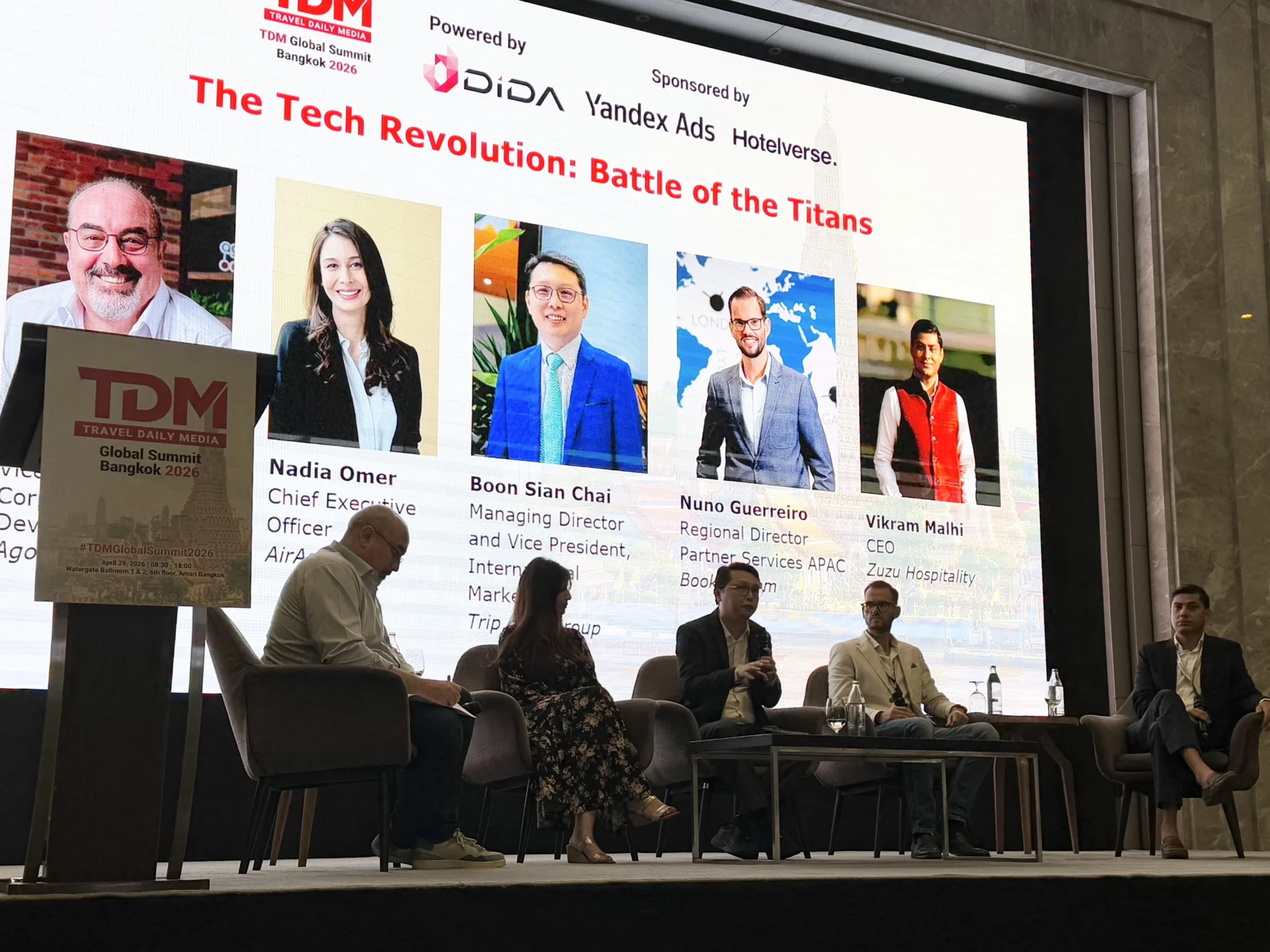
Even amid shifting geopolitics, capacity constraints, and economic uncertainty, one thing remains remarkably resilient: people still want to travel. That was the backdrop for a spirited panel discussion at the TDM Global Summit Bangkok 2026 titled The Tech Revolution: Battle of the Titans, where some of the biggest names in travel technology explored how fintech, loyalty, and artificial intelligence are reshaping the future of distribution and traveler engagement.
Moderated by Timothy Hughes, Vice President Corporate Development at Agoda, the session brought together Nadia Omer, Chief Executive Officer, AirAsia MOVE; Boon Sian Chai, Managing Director and Vice President, International Markets, Trip.com Group; and Nuno Guerreiro, Regional Director Partner Services APAC, Booking.com for a sweeping conversation on the direction of travel technology and potential shapers of its next chapter.
Demand Is Shifting, Not Disappearing
The panel opened with a strong sense of optimism regarding travel demand, despite disruptions in select markets. Thailand, the panellists noted, has remained resilient, buoyed by robust regional demand from countries such as Malaysia, India, and China. While some long-haul dependent destinations have felt pressure from capacity constraints and rising airfares, the broader message emphasized that travel demand has not diminished — it has simply become more regional, adaptive, and fragmented.
For Chai, that resilience is reflected in transport patterns, with significant growth in rail travel across Europe and an upswing in domestic and regional travel in markets like the Gulf. The conclusion is clear: travel demand is persistent, and the opportunity lies in identifying and adapting to its shifts.
Fintech Moves From Support Function to Strategic Weapon
The discussion quickly shifted to fintech, which panellists agreed has transitioned from a peripheral role to a key competitive advantage. Payments, once regarded as backend infrastructure, have become integral to trust, conversion, convenience, and cost.
Offering local payment solutions, mobile wallets, buy-now-pay-later facilities, and alternative payment processing options is no longer just a checkbox; it’s about enhancing accessibility and minimizing friction. This is especially crucial for emerging and budget travelers. Omer asserted that significant opportunities exist beyond traditional credit systems, where effective use of transaction data and banking partnerships could enhance travel access for large underserved segments.
Flexibility, they noted, is becoming ingrained in the travel product itself, transforming payments into experience differentiators, not just transactional tools.
The Next Payments Frontier Is B2B
While consumer payments have rapidly evolved, hotel payments tend to be less efficient. Despite significant advancements for travelers, accommodations frequently deal with fragmented and manual reconciliation processes across various channels and payment models.
This discrepancy may present one of travel tech’s next major opportunities, prompting discussions on the automation of virtual cards, reconciliation systems, and supplier payment workflows as essential areas for innovation.
Loyalty Is Being Rewritten
If payments are evolving, loyalty programs face reinvention. Panellists suggested that traditional points systems are increasingly challenged by immediate, value-driven benefits that matter more to travelers than abstract rewards.
Benefits such as access to lounges, room upgrades, airport transfers, and practical enhancements take precedence over points accumulation. Chai contended that loyalty is transitioning from points-focused to travel utility, where membership facilitates meaningful experiences instead of distant redemption promises.
Moreover, loyalty’s definition is expanding; it intertwines closely with comprehensive customer experiences — ranging from booking to support, and service recovery to personalisation.
AI Becomes the Baseline
Artificial intelligence dominated the latter part of the panel’s discussion. Rather than indulging in hype, the conversation turned practical, emphasizing AI’s implications for hotel partners and suppliers potentially lacking in-house tech capabilities.
The consensus is that AI is evolving from an optional tool to a foundational layer in operations. The pertinent question is how the industry will implement AI, not whether it will.
Innovation Beyond the Giants
The panel exhibited notable interest in startups and emerging technologies, emphasizing spaces such as specialist travel, loyalty simplification, and experience-led technologies. Several panelists suggested that the most compelling innovations may not be within mainstream travel sectors but in underserved niches, where significant portions of transactions still occur offline globally.
As the discussion illustrated, travel technology is converging; payments, loyalty, content, AI, and distribution are increasingly interconnected. Competitive advantage is less about controlling isolated capabilities and more about orchestrating all components around the traveler.
Despite the disruption, the panel concluded on a surprisingly hopeful note: demand is still strong, and the true opportunity lies in consistently innovating to meet travelers’ enduring desire to explore.