UAE Economy Experiences Severe Stress Test Amid US-Iran Tensions
The ongoing US-Iran conflict has significant implications for the UAE's economy, particularly affecting its aviation, tourism, and hospitality sectors.
UAE Economy Experiences Severe Stress Test Amid US-Iran Tensions
The escalating US–Iran conflict has triggered immediate and severe economic consequences for the United Arab Emirates, underscoring how geopolitical tensions can rapidly disrupt one of the world’s most globally integrated business hubs.
The crisis intensified after Israel and the United States launched what officials described as a “massive” strike targeting Iran’s leadership and military infrastructure, resulting in the reported death of Supreme Leader Ayatollah Ali Khamenei. US President Donald Trump confirmed the development and warned that further retaliation would be met with “a force that has never been seen before,” adding that US operations would continue “uninterrupted throughout the week or, as long as necessary.”
Iran’s response has included large-scale drone and missile strikes across the region, with explosions reported in Dubai, Abu Dhabi, and Doha. For the UAE, the impact has been swift—particularly across aviation, hospitality, tourism, trade, and investor sentiment.
Aviation Paralysis: A Direct Hit to a Global Hub
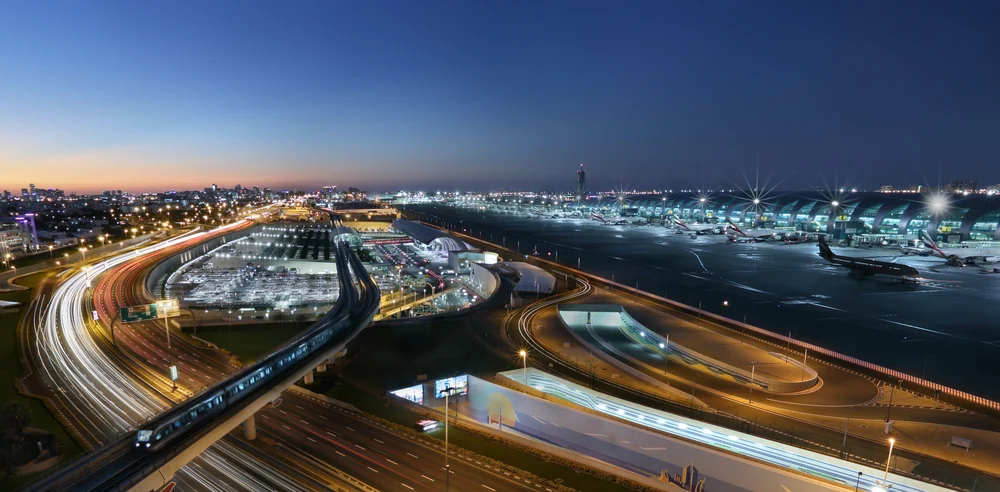
The most immediate disruption has been in aviation. Over 700 flights across Gulf countries and the wider Middle East were cancelled as of Sunday amid rising tensions. Flight tracking data from FlightRadar24 showed the airspace above Dubai nearly empty, with all flights to and from Dubai International Airport (DXB) cancelled as of Sunday morning. Four people were reported injured at the airport during the strikes.
DXB, Gateway to the Gulf Shut
For Dubai, this is not merely a transportation issue—it is a business shock. DXB is one of the world’s busiest international transit hubs, serving as a key connector between Europe, Asia, and Africa. Emirates Airline’s long-haul network depends heavily on uninterrupted airspace access across the Gulf.
Airspace in Qatar has also been closed. Qatar Airways flight operations remain temporarily suspended due to the closure of Qatari airspace. The airways have deployed additional ground staff at Hamad International Airport and other key airports to assist affected passengers.
Extended airspace closures or ongoing security risks could significantly disrupt the aviation sector by increasing fuel and rerouting costs for airlines, triggering cascading global schedule disruptions, and constraining cargo and high-value freight movement. Such challenges would also dampen airport retail and duty-free revenues as passenger flows decline or shift. Given that aviation and related services are a central pillar of Dubai’s non-oil economy, any prolonged disruption would place substantial pressure on overall economic activity and weigh meaningfully on GDP growth.
Hospitality and Tourism Disruption
The recent wave of drone and missile strikes on Dubai has notably disrupted the emirate’s hotel and hospitality sector, challenging its reputation as a secure, high-end travel destination.
The hospitality and tourism sector—one of the UAE economy’s key pillars—has come under significant pressure, placing Dubai’s global brand at risk. Major landmarks, including Dubai International Airport, Palm Jumeirah, and the Burj Al Arab, were reportedly affected during retaliatory strikes. Footage cited by The Mirror showed a five-star hotel on Palm Jumeirah engulfed in flames, with thick smoke rising above the luxury waterfront development.
As a symbol of premium tourism and high-end real estate, Palm Jumeirah is central to Dubai’s international image. The fallout carries serious business implications, including immediate booking cancellations, rising insurance costs for hospitality assets, potential credit rating reassessments for hotel operators, and mounting pressure on short-term rental and real estate markets. Having welcomed millions of international visitors annually prior to the crisis and positioned itself as a safe, stable regional hub, Dubai now faces the risk that images of damaged luxury properties could erode years of strategic brand-building investment.
Luxury properties such as the Fairmont The Palm were struck and set alight, while debris from intercepted drones also ignited fires at the iconic Burj Al Arab, forcing evacuations and emergency responses at major hotels and landmarks. These attacks have rattled international tourists and expatriates, with many caught off guard and taking shelter amid sudden alerts, and have led to airport closures and widespread flight cancellations, compounding travel disruptions that directly hit hotel occupancy and bookings.
The strikes have also undermined Dubai’s long-cultivated image as a calm, business-friendly tourism hub, prompting revised travel advisories and uncertainty about future visits, potentially affecting demand in a sector that heavily depends on global confidence. Dubai’s diversified economy—less reliant on oil—remains vulnerable to downturns in travel, retail, and services.
The US–Iran conflict represents one of the most serious regional escalations in recent years. For the UAE, the crisis is not only a security challenge but a comprehensive business stress test.
Aviation shutdowns, damage to high-profile hospitality assets, and investor uncertainty have immediate economic consequences. Longer-term risks will depend on whether tensions escalate into sustained regional warfare or de-escalate through diplomatic channels.
As one of the world’s most globally connected economies, the UAE’s strength has always been its openness. The coming weeks will determine how quickly it can restore operational stability—and reassure global markets that Dubai and Abu Dhabi remain secure platforms for commerce in an increasingly volatile region.